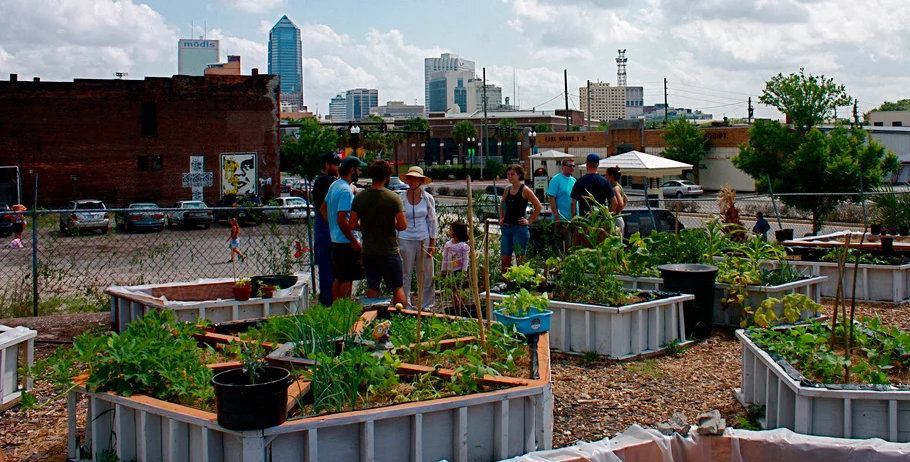
A City Council bill would allow community and market gardens, with backyard hens, in most Jacksonville zoning districts. The first hearing is 5 p.m. Tuesday.
Community gardens and small market gardens would become a permitted use across most of Jacksonville’s residential and commercial zoning districts under a bill that gets its first public hearing Tuesday.
Ordinance 2026-807 is item 35 on the City Council agenda for Tuesday, Nov. 10. The meeting starts at 5 p.m. in the Council Chamber at City Hall. Council members Jimmy Peluso and Raul Arias introduced the bill Oct. 13. Council member Ju’Coby Pittman is a co-sponsor.
The council will not vote on it Tuesday. The agenda lists a second council hearing Nov. 24, and the Land Use and Zoning Committee has its own hearing set for Nov. 17. Three committees deferred the bill in their meetings Nov. 2 and Nov. 4, the bill’s Legistar record shows.
Part of the city’s new food plan
The bill is the zoning piece of the Jacksonville Food Plan, which Mayor Donna Deegan unveiled Oct. 26 at Feeding Northeast Florida. The plan lists 32 actions and 79 sub-actions on how food is grown, moved, reached and recovered in the city.
In the city’s release, Deegan said nearly one in seven Jacksonville residents and one in five children are experiencing food insecurity. The release calls the bill “Pathways to Urban Agriculture” and says it would make it easier for community gardens, market gardens and urban farms to grow and sell food within city limits.
What the bill does
The bill as filed writes three new terms into the zoning code:
- Community garden: land that a person or group farms for food, plants or flowers, in shared or separate plots. No sales on site.
- Market garden: the same, run by a person, group or business, with sales of what is grown there allowed on site.
- Urban agriculture: the umbrella term for growing, washing, packing, storing and selling produce for personal use, donation or sale.
Both kinds of garden would be allowed in these districts:
- the rural, low, medium and high density residential districts (RR-Acre, RLD, RMD-A to RMD-D, RHD-A and RHD-B)
- the commercial office, residential office and neighborhood and community commercial districts (CO, CRO, RO, CN, CCG-1 and CCG-2)
- the Springfield historic districts (RMD-S and CRO-S) and the Mayport Village residential district (RLD-M)
In the CN, CCG-1 and CCG-2 commercial districts, the gardens would not have to meet the new standards at all.
The rules a garden would follow
Everywhere else, the bill sets these limits:
| Rule | Community garden | Market garden |
|---|---|---|
| Sales on site | Not allowed | Up to 12 public sales days a year, sunrise to sunset |
| Largest garden area | 2.5 acres | 2.5 acres |
| Structures | Up to 15 feet tall, covering no more than 25% of the lot | Same |
| Signs | One unlit flat sign up to 6 square feet | Same |
| Heavy equipment over 5,000 pounds | Not stored overnight; out of sight unless work is underway | Same |
For a market garden, individual sales and prearranged pickups with no more than five customers on site at a time would not count as a public sales day. Classes and community events at a market garden would count toward the 12 days.
Greenhouses, hoop houses, sheds, trellises, shade pavilions, wash and pack areas and cold storage are all allowed. Any structure 30 inches or taller would need the usual permits and would have to meet the Florida Building Code and Fire Code. Gardens in a local historic district would also have to follow that district’s rules. Beekeeping, composting, pesticide use and food handling stay under existing city, state and federal rules.
Nothing in the bill limits selling a garden’s produce somewhere else, such as a farmers market.
Backyard hens
The city already allows backyard hens by permit with a single-family home. The bill adds community gardens and market gardens to that list. The code counts only female chickens.
The Council Research Division summary says the change would cost the city nothing.
What it means for you
- If you want to start a neighborhood garden, the bill would make it a permitted use in the city’s main residential districts, within the limits above.
- If you want to sell what you grow, a market garden could open to the public on up to 12 days a year. Small pickups would not count against that.
- If you want to comment, public hearings are Tuesday, Nov. 10, and Tuesday, Nov. 24, before the full council, and Tuesday, Nov. 17, before the Land Use and Zoning Committee. Council rules limit hearing comments to the bill’s subject.
- If a garden opens next door, the bill caps structure height and coverage and bans overnight storage of heavy equipment.
The bill can still be amended in committee. We will report what the council decides. For other zoning questions, see our guide to building permits and zoning in Jacksonville.
Frequently asked questions
When is the public hearing on Jacksonville’s urban agriculture bill?
Ordinance 2026-807 is item 35 on the City Council agenda for 5 p.m. Tuesday, Nov. 10, in the Council Chamber on the first floor of City Hall, 117 W. Duval St. The Land Use and Zoning Committee holds its hearing Nov. 17, and the council holds a second hearing Nov. 24.
Could a Jacksonville market garden sell vegetables on site?
Yes, under the bill as filed, on up to 12 public sales days a year between sunrise and sunset. Individual sales and prearranged pickups with no more than five customers on site at a time would not count as a sales day. Community gardens could not sell on site.
Does the bill change Jacksonville’s backyard chicken rules?
It adds community gardens and market gardens to the places where backyard hens are allowed by permit. Today the code allows them with a single-family home. Only female chickens count as backyard hens.
Have your say