Jacksonville was laid out in 1822 and named for Andrew Jackson. Its 109 National Register listings, the Great Fire of 1901 and where to visit.
Last checked Oct. 9, 2026. Updated each year. History comes from Visit Jacksonville, the Jacksonville History Center (the Jacksonville Historical Society), the Jacksonville Sheriff’s Office history and the National Park Service. National Register listings are from the Park Service’s listed-properties file.
Jacksonville grew from a cattle crossing on the St. Johns River into the largest city by land area in the continental United States. Its downtown was rebuilt almost from scratch after the Great Fire of 1901, and the National Park Service now lists 109 properties and districts across the consolidated city.
Visit and ask
- Fort Caroline National Memorial and Kingsley Plantation: grounds open 9 a.m. to 5 p.m. Wednesday to Sunday; 904-641-7155 (hours)
- Jacksonville History Center: 314 and 318 Palmetto St.; Merrill House tours by appointment, 904-665-0064
- City Historic Preservation Section: 214 N. Hogan St., Suite 300; 904-255-7800 (city page)
How Jacksonville began
- About 500 B.C.: archaeologists date the start of the distinctive Timucuan culture here, according to Visit Jacksonville.
- May 1, 1562: French explorer Jean Ribault found the mouth of the River of May, today’s St. Johns.
- June 30, 1564: René de Laudonnière’s French colonists founded la Caroline. Spanish forces captured the fort on Sept. 20, 1565, according to the Park Service’s Fort Caroline chronology.
- 1763 to 1783: under British rule, plantations lined the river, the King’s Road linked Savannah to St. Augustine, and a narrow river crossing was named Cowford.
- 1821: Florida became a U.S. territory.
- 1822: two settlers donated land on the north bank at Cowford for a town, renamed Jacksonville for Andrew Jackson, the territory’s first provisional governor, who never visited.
- 1861 to 1865: Union troops occupied the port city four times during the Civil War.
- May 3, 1901: the Great Fire began in LaVilla and destroyed 2,368 homes and buildings in eight hours, most of downtown, according to the Jacksonville Historical Society. Within two years the city had more buildings than before the fire.
- Early 1900s: architect Henry Klutho brought the Prairie style downtown, a Carnegie library opened in 1905, and silent-film studios worked here until World War I.
- World War II: three military installations made Jacksonville the Navy’s third-largest complex in the country.
- Oct. 1, 1968: the City of Jacksonville and Duval County consolidated, after voters approved the merger in August 1967 with 65% of the vote, according to the Sheriff’s Office. The new city covers nearly 900 square miles.
- 1993: the NFL awarded the city the Jaguars.
Downtown and the historic districts
The Park Service lists the Downtown Jacksonville Historic District, bounded roughly by North Pearl, Beaver and North Catherine streets and Independent and Courthouse drives. The St. James Building at 117 W. Duval St., one of the post-fire buildings the historical society counts among the city’s “great saves,” is now City Hall. Residential districts on the register are Riverside (1985), Springfield (1987), Avondale (1989), Old Ortega (2004), Durkee Gardens (2020) and Eastside (2023).
The city also designates local landmarks and districts through the Jacksonville Historic Preservation Commission; work on them needs a certificate of appropriateness. See building permits and zoning.
National Register of Historic Places
The Park Service lists 109 properties in Jacksonville, including Mandarin and Mayport, oldest listing first. Jacksonville Beach, a separate city, has two more.
| Property | Address | Listed |
|---|---|---|
| Fort Caroline National Memorial | 12713 Fort Caroline Road | Oct. 15, 1966 |
| Kingsley Plantation | Fort George Island, 11676 Palmetto Ave. | Sept. 29, 1970 |
| Yellow Bluff Fort | New Berlin Road, 1 mile south of State Road 105 | Sept. 29, 1970 |
| Old St. Luke’s Hospital | 314 N. Palmetto St. | July 24, 1972 |
| Riverside Baptist Church | 2650 Park St. | Sept. 22, 1972 |
| Red Bank Plantation | 1230 Greenridge Road | Oct. 18, 1972 |
| Napoleon Bonaparte Broward House | 9953 Hecksher Drive | Dec. 27, 1972 |
| Epping Forest | Christopher Point, off San Jose Boulevard | May 9, 1973 |
| Grand Site (archaeological) | address restricted | June 20, 1975 |
| St. James Building | 117 W. Duval St. | May 3, 1976 |
| Centennial Hall, Edward Waters College | 1658 Kings Road | May 4, 1976 |
| St. Andrew’s Episcopal Church | 317 Florida Ave. | May 4, 1976 |
| Brewster Hospital | 915 W. Monroe St. | May 13, 1976 |
| Thomas V. Porter House | 510 Julia St. | May 13, 1976 |
| St. John’s Lighthouse, Mayport | U.S. Naval Station | June 3, 1976 |
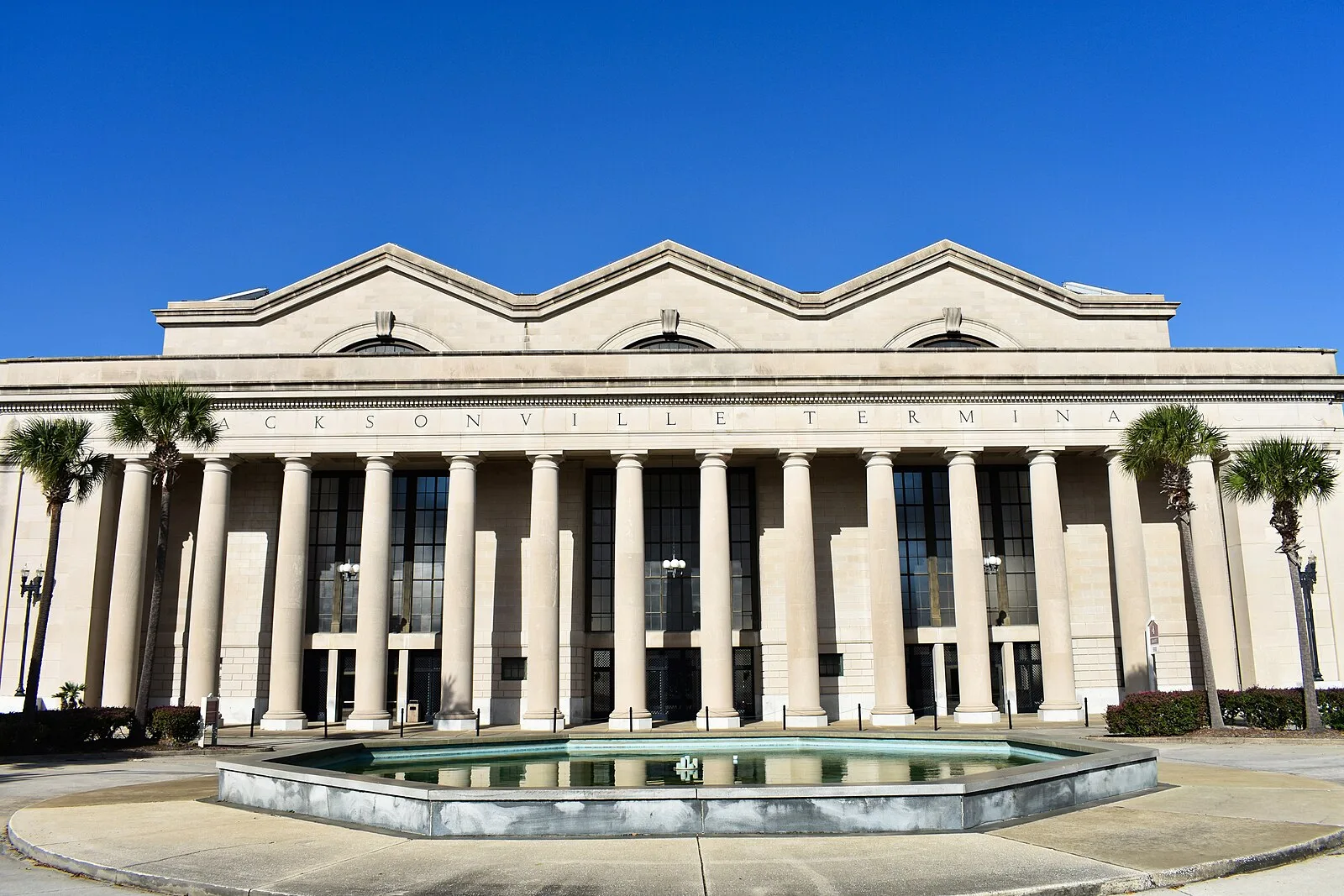
| Jacksonville Terminal Complex | 1000 W. Bay St. | Oct. 22, 1976 |
| Bethel Baptist Institutional Church | 1058 Hogan St. | April 6, 1978 |
| Henry John Klutho House | 28-30 W. Ninth St. | Dec. 19, 1978 |
| John S. Sammis House | 207 Noble Circle West | July 10, 1979 |
| Morocco Temple | 219 Newnan St. | Nov. 29, 1979 |
| Dyal-Upchurch Building | 4 E. Bay St. | April 17, 1980 |
| Masonic Temple | 410 Broad St. | Sept. 22, 1980 |
| El Modelo Block | 513 W. Bay St. | Oct. 16, 1980 |
| Florida Theater | 128-134 E. Forsyth St. | Nov. 4, 1982 |
| Lane-Towers House | 3730 Richmond St. | Nov. 10, 1982 |
| 310 West Church Street Apartments | 420 N. Julia St. | April 7, 1983 |
| Edwin M. Stanton School | 521 W. Ashley St. | Sept. 29, 1983 |
| Florida Baptist Building | 218 W. Church St. | Jan. 12, 1984 |
| Riverside Historic District | Riverside and Memorial parks to the St. Johns River | March 22, 1985 |
| 24 San Jose Estates buildings (see below) | San Jose | April 10, 1985 |
| Mission of San Juan del Puerto (archaeological) | address restricted | March 25, 1986 |
| Old Jacksonville Free Public Library | 101 E. Adams St. | Jan. 22, 1987 |
| Springfield Historic District | First to 12th streets, Hogans Creek to Boulevard | Jan. 22, 1987 |
| Timucuan Ecological and Historic Preserve | 13165 Mount Pleasant Road | Feb. 16, 1988 |
| Village Store | Oxford Avenue and Corinthian Avenue, Avondale | Sept. 29, 1988 |
| San Jose Estates Gatehouse | 1873 Christopher Point Road North | Dec. 20, 1988 |
| Avondale Historic District | Roosevelt Boulevard to the St. Johns River | July 6, 1989 |
| Title & Trust Company of Florida Building | 200 E. Forsyth St. | Feb. 23, 1990 |
| Carling Hotel | 33 W. Adams St. | Feb. 28, 1991 |
| Little Theatre | 2032 San Marco Blvd. | July 12, 1991 |
| Young Men’s Hebrew Association | 712 W. Duval St. | Oct. 29, 1992 |
| Church of the Immaculate Conception | 121 E. Duval St. | Dec. 30, 1992 |
| Groover-Stewart Drug Company Building | 25 N. Market St. | Dec. 30, 1992 |
| Mount Zion AME Church | 201 E. Beaver St. | Dec. 30, 1992 |
| Plaza Hotel | 353 E. Forsyth St. | Dec. 30, 1992 |
| Maple Leaf shipwreck site, Mandarin | address restricted | Oct. 12, 1994 |
| Lewis Mausoleum | Memorial Cemetery, Edgewood Avenue and Moncrief Road | Oct. 24, 1997 |
| Atlantic National Bank Annex | 118 W. Adams St. | Nov. 7, 1997 |
| Elks Club Building | 201-213 N. Laura St. | March 9, 2000 |
| Ribault Inn Club | Fort George Road | May 11, 2000 |
| Mandarin Store and Post Office | 12471 Mandarin Road | Oct. 1, 2001 |
| St. George Episcopal Church | 10560 Fort George Road East | Aug. 9, 2002 |
| Lynch Building | 11 Forsyth St. | Dec. 23, 2003 |
| South Jacksonville Grammar School | 1450 Flagler Ave. | April 15, 2004 |
| Old Ortega Historic District | Roosevelt Boulevard to the St. Johns and Ortega rivers | July 14, 2004 |
| W.A. Knight Building | 113 W. Adams St. | March 15, 2005 |
| Hutchinson-Suddath Building | 315-319 E. Bay St. | Oct. 3, 2007 |
| Cummer Gardens | 829 Riverside Ave. | Jan. 25, 2010 |
| Evergreen Cemetery | 4535 N. Main St. | April 8, 2011 |
| Snyder Memorial Methodist Episcopal Church | 226 N. Laura St. | March 13, 2013 |
| Joseph H. Durkee Athletic Field | 1701 Myrtle Ave. | July 11, 2013 |
| Marabanong | 4747 River Point Road | Dec. 11, 2013 |
| Norman Film Studios | 6337 Arlington Road | Dec. 29, 2014 |
| Downtown Jacksonville Historic District (additional documentation) | Downtown | May 2, 2016 |
| Norman Film Manufacturing Company (National Historic Landmark) | 6337 Arlington Road | Oct. 31, 2016 |
| Memorial Park | Memorial Park Drive | Oct. 25, 2017 |
| St. Johns Light | Naval Station Mayport | March 20, 2018 |
| Henry C. Arpen House | 3318 O’Connor Road | Aug. 26, 2019 |
| Unitarian Universalist Church of Jacksonville | 7405 Arlington Expressway | Oct. 15, 2019 |
| Memorial Cemetery | Moncrief Road and Edgewood Avenue West | Feb. 5, 2020 |
| Mount Calvary Baptist Church | 301 Spruce St. | March 16, 2020 |
| Durkee Gardens Historic District | Myrtle Avenue to Wilcox Street, Eighth to 13th streets | March 16, 2020 |
| Palm Spring Cemetery | 11396 Fort Caroline Road | Nov. 24, 2020 |
| Union Terminal Company Warehouse | 700 E. Union St. | April 1, 2021 |
| Jacksonville Jewish Center | 205 W. Third St. | April 2, 2021 |
| Clifton Cemetery | Garrison and Magnolia Bluff avenues | April 15, 2022 |
| Edward Waters College Historic District | 1658 Kings Road | Aug. 8, 2022 |
| Bishop Henry Y. Tookes Residence | 1011 W. Eighth St. | Aug. 9, 2022 |
| West 4th Street Church of God | 723 W. Fourth St. | Sept. 27, 2022 |
| St. Matthews Methodist Episcopal Church | 825 W. Monroe St. | Oct. 6, 2022 |
| The Garden Club of Jacksonville | 1005 Riverside Ave. | April 20, 2023 |
| Eastside Historic District | East Seventh Street to the Arlington Expressway | July 3, 2023 |
| Duval County Armory | 851 N. Market St. | July 27, 2023 |
| Tolbert House | 1665 Pearce St. | Oct. 20, 2023 |
| Clara White Mission | 611-615 W. Ashley St. | April 18, 2025 |
| Atlantic Coast Line Railroad Locomotive No. 1504 | 1000 W. Bay St. | not dated in the file |
San Jose Estates, all listed April 10, 1985: the San Jose Hotel, San Jose Country Club and San Jose Administration Building, and 21 houses: 3325, 3335, 3500, 3609, 3685 and 3703 Via de la Reina; 3764 Ponce de Leon Ave.; 7144 Madrid Ave.; 7207, 7217 and 7330 Ventura Ave.; 7227 and 7249 San Pedro Road; 7245, 7288, 7317, 7356 and 7400 San Jose Blvd.; 7246 San Carlos; and 7246 and 7306 St. Augustine Road.
Places to visit
- Fort Caroline National Memorial, 12713 Fort Caroline Road: the visitor center for the Timucuan Preserve. Grounds 9 a.m. to 5 p.m. Wednesday to Sunday; the Ribault Monument closes at 4:45 p.m.
- Kingsley Plantation, 11676 Palmetto Ave. on Fort George Island: grounds 9 a.m. to 5 p.m. Wednesday to Sunday; weekend open houses of the planter’s home 10 a.m. to noon and 2 to 4 p.m., according to the Park Service.
- Jacksonville History Center, 314 and 318 Palmetto St.: the restored 1920 Florida Casket Company building opened in spring 2025 beside Old St. Luke’s Hospital (1878), which the center calls Florida’s first purpose-built hospital. It also cares for Old St. Andrew’s Church (1888), the only major church to survive the 1901 fire, and the James E. Merrill House (1879), open for tours by appointment at 904-665-0064.
- Mandarin Museum, Walter Jones Historical Park, 11964 Mandarin Road: 10 a.m. to 4 p.m. Tuesday to Saturday; the park is open sunrise to sunset. The Mandarin Store and Post Office, 12471 Mandarin Road, opens 10 a.m. to 2 p.m. on the first Saturday of each month, according to the museum.
- Cemeteries on the register: Evergreen (4535 N. Main St.), Memorial, Clifton and Palm Spring.
All Park Service sites in the preserve close on Thanksgiving, Dec. 25 and Jan. 1.
Related: population and growth, parks and trails, things to do this month and Jacksonville, Duval County and the neighbors.
Frequently asked questions
When was Jacksonville founded?
Two settlers donated land on the north bank of the river crossing known as Cowford to lay out a town in 1822, and it was renamed Jacksonville for Andrew Jackson, Florida’s first territorial governor, according to Visit Jacksonville.
When did Jacksonville and Duval County consolidate?
On Oct. 1, 1968, after voters approved consolidation in August 1967 with 65% of the vote, according to the Jacksonville Sheriff’s Office history.
What was the Great Fire of 1901?
A fire on May 3, 1901, that began in LaVilla and destroyed 2,368 homes and buildings in eight hours, most of downtown, according to the Jacksonville Historical Society.
How many National Register sites are in Jacksonville?
The National Park Service lists 109 properties and districts in Jacksonville, including Mandarin and Mayport, from Fort Caroline (1966) to the Clara White Mission (2025).
When are Fort Caroline and Kingsley Plantation open?
The grounds are open 9 a.m. to 5 p.m. Wednesday through Sunday and closed on Thanksgiving, Dec. 25 and Jan. 1, according to the National Park Service. The park’s phone is 904-641-7155.
Have your say